






How Two-stage Dental Procedures Work
Lakewood Animal Hospital is joining other innovative veterinary practices who offer split, two-staged dental procedures.

About Two Stage Dentals
In the past, our dental procedures for veterinary patients were typically one extended anesthetic event with unpredictable length. Depending on what was discovered once the patient was anesthetized, this procedure could last anywhere from 1 to 4 hours. Our new two-appointment protocol reduces the risk of anesthesia by splitting the process into two shorter, safer, and more predictable procedures.

Stage 1:
- teeth cleaning
- full mouth x-rays
- complete oral examination
Stage 2:
- oral surgery
- tooth extractions
Frequently Asked Questions
The main advantage is to make the process safer for your pet!
By preventing your pet from being under anesthesia for an excessively long period of time, we reduce the chance of adverse effects such as low blood pressure (hypotension) and low body temperature (hypothermia). Two shorter procedures increase the likelihood of smoother and quicker recoveries from anesthesia each time.
Another advantage is alleviating any stress associated with the unpredictable cost of one long dental procedure. We can give you a much narrower range for an estimate for your pet’s stage one procedure. Then after the first stage, we will have a more exact estimate of the cost of any oral surgery that may be required to treat the specific diseased teeth identified during the stage one procedure.
Stage 1 - Teeth Cleaning, Full-mouth X-rays, Complete oral examination
- Veterinarian conducts pre-op exam and discusses any issues or changes with the pet owner prior to starting.
- Pre-op bloodwork performed to ensure patient is safe to be anesthetized. (This may be completed prior to the day of the procedure).
- Patient is given a pre-med of pain medication and sedative to keep them comfortable and calm prior to anesthesia.
- Intravenous catheter (an “IV”) is placed to allow medication and IV fluid administration.
- Patient is given an IV medication to induce general anesthesia, an endotracheal (breathing) tube is placed in the airway to administer gas anesthesia and protect the airway during the procedure, and monitoring equipment is connected to closely observe vital signs.
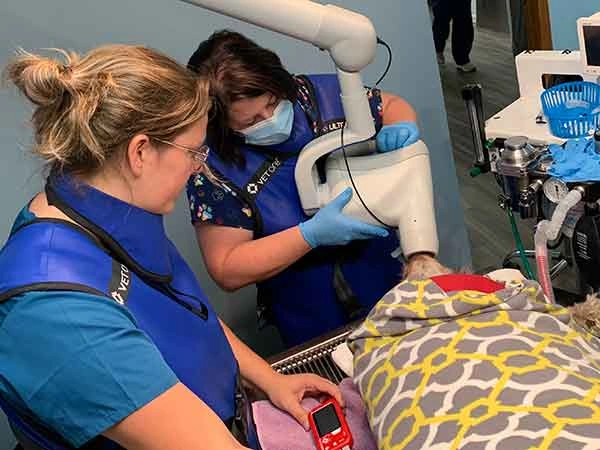
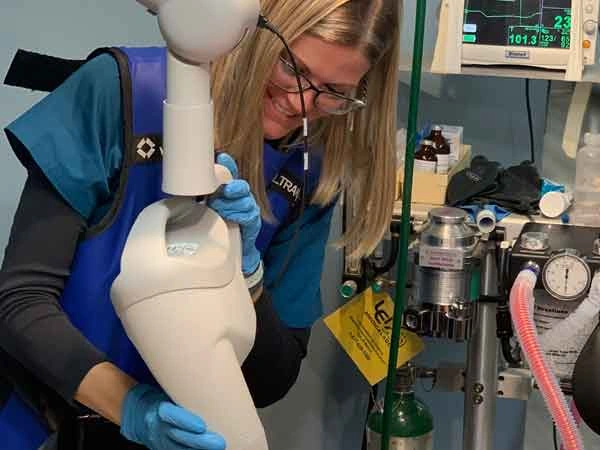
- Full mouth dental X-rays taken by a veterinary technician and evaluated by a doctor.
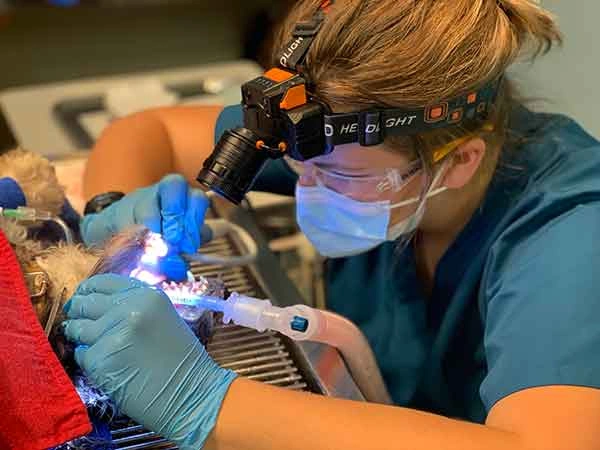
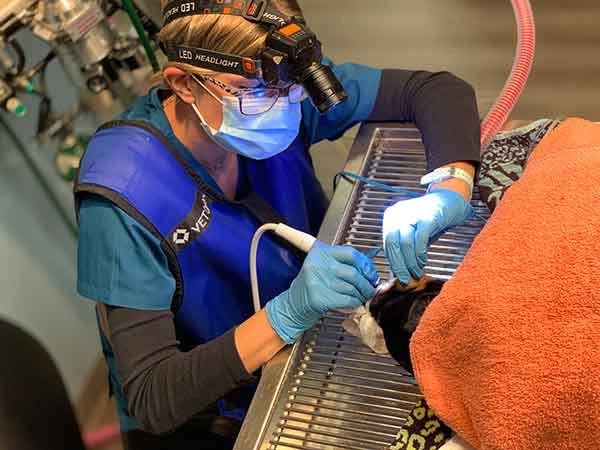
- Teeth Cleaning performed – including ultrasonic subgingival scaling and application of polish.
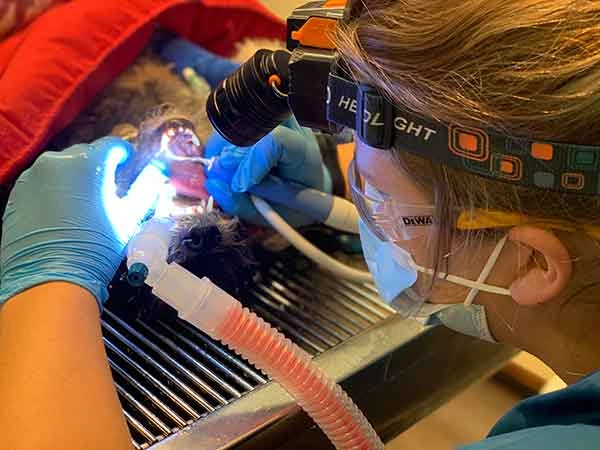
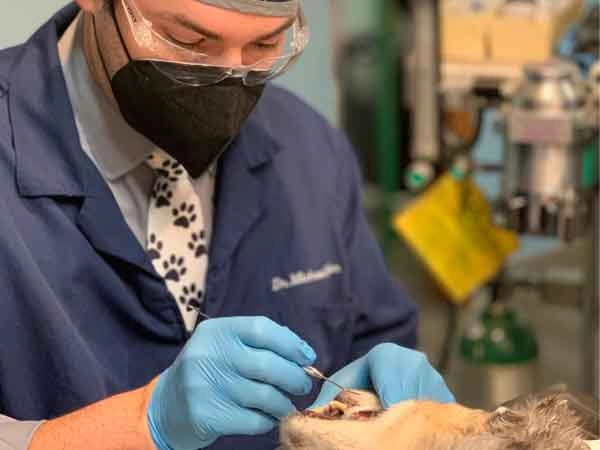
- Complete oral exam and dental charting of each tooth to note any abnormalities.
- Possible extraction of any severely diseased teeth that are considered "simple extractions".
- Recovery of patient from anesthesia while closely monitored by the surgical team. Patients can continue to be groggy for a while after anesthesia, so we prefer to keep them in the hospital until they can pass their field sobriety test to go home.
- Communication with pet owner to let them know that the procedure is completed and relaying the findings from the X-rays and exam.
- Scheduled discharge from hospital, including discussion about post-anesthesia care and a treatment plan for Stage 2 dental if indicated.
Stage 2 - Tooth Extractions or other Oral Surgery
- Veterinarian performs pre-op exam and discusses any issues or changes with the pet owner prior to starting.
- Patient is given a pre-med of pain medication and sedative to keep them comfortable and calm prior to anesthesia.
- Intravenous catheter (an "IV") is placed to allow medication and fluid administration.
- Patient is given an IV medication to induce general anesthesia, an endotracheal (breathing) tube is placed in the airway to administer gas anesthesia and protect the airway during the procedure, and monitoring equipment is connected to closely observe vital signs.
- Tooth extractions or other necessary oral surgery is performed.
- Absorbable sutures may be placed to close oral surgery sites.
- Post-extraction X-rays obtained to confirm complete extraction of tooth root tips.
- Recovery of patient from anesthesia while closely monitored by the surgical team. Patients can continue to be groggy for a while after anesthesia, so we prefer to keep them in the hospital until they can pass their field sobriety test to go home.
- Communication with pet owner to let them know that the procedure is completed and relaying any information about the oral surgery.
- Scheduled discharge from hospital, including discussion of post-op care, review of treatments, and instructions for any follow-up.
Honestly, our prices have increased over the past few years, and we currently perform full-mouth X-rays with every teeth cleaning, so the cost for a dental procedure for your pet now will likely be more than it was in previous years.
However, that increase in cost will not be due to this new structure of splitting the procedure into two appointments. We have taken this into consideration when determining the pricing of our staged dental procedures so that the total cost in the end would be comparable to what would be charged if everything was done in one appointment.
If your pet can undergo one anesthesia, then we do not have any concerns about them coping with a second anesthesia.
Our anesthetic protocols are tailored to each individual patient based on their health needs to increase safety.
In addition, every pet is closely monitored by a certified veterinary technician as well as multi-parameter anesthetic monitoring equipment.
Anesthesia always involves some level of risk, and we strive to minimize that risk as much as possible. If you have questions about how we can further reduce your pet’s risk for anesthesia, please ask us!
We have better choices for anesthetic drugs and better monitoring equipment than in the past. So, if you were told in the past that your last pet was too old for a dental procedure, that may no longer be the case.
The best way to determine if your pet is healthy enough to undergo anesthesia for a dental procedure is to start with a doctor’s exam and pre-op bloodwork.
During your pet’s stage 1 procedure, a thorough oral exam as well as full-mouth dental X-rays will be used to evaluate the health of every tooth. If diseased teeth or jaw bone are discovered, then treatment is required to manage pain, prevent future spread of infection, and allow your pet to eat comfortably.
If left untreated, dental disease can lead to other health issues and decrease your pet’s expected lifespan.
Sometimes. If there are any teeth that are very loose and considered a "simple extraction", then it is up to the doctor to determine if those teeth could be extracted during the stage one procedure.
However, most diseased teeth will require surgical extraction and will be treated during a stage two procedure.
Ongoing dental care at home should be provided to maintain a healthy mouth. This can include dental chews, daily brushing with enzymatic toothpaste, oral rinses, special diets, and other options.
We will also continue to evaluate your pet’s teeth whenever they come in for their wellness check-ups.
If you have any questions about how to keep your pet’s mouth healthy based on their individual lifestyle, please ask!
Similar to when we go to the dentist, the dental procedure will address any current disease present at that time, but it cannot prevent the development of future dental disease. Some patients are more prone to dental disease and may require an annual, or even semi-annual, dental procedure to clean their teeth and assess for any newly diseased teeth.
The fastest way to get your specific questions answered is to text us at 815-942-1199 with your questions.
Gallery